2025 Yearly Theme: Being Present
If you have kids, or have ever been a kid, you know how exciting the anticipation of a huge event can be.
Since November 1st — the day after Halloween — my kids have been excited about Christmas, entirely ignoring the Thanksgiving buffer.
None were more excited that my oldest, who would do impressive math for a 7-year-old to figure out just how many days, events, sleeps, and school days there were until Santa came to visit.
On the day we got our Christmas tree — November 29th — I reminded her: “Be present. Christmas is one day, but it’s up to us to enjoy the season, and all the activities we’re doing.”
I felt like Qui-Gon Jinn telling Anakin to, “concentrate on the moment,” before the pod race.
My point was that I didn’t want her to spend the entire Christmas season anticipating Christmas Day while mentally missing out on everything we were doing. From cutting down our tree, to Christmas concerts, baking cookies, visiting family, and everything else, there are many wonderful things about that time of the year.
But I also realized something: I do a pretty bad job of concentrating on the moment. Instead, I worry about the future. Or I escape into my phone. Or my work.
I try to address problems I worry will happen, and defer solutions to problems I need to address today.
I need to follow the advice I gave my daughter. That’s why my Yearly Theme for 2025 is The Year of Being Present.
But before we get into that, let’s grade my previous yearly theme: The Year of Control.
Grading The Year of Control
With a name like “The Year of Control,” it feels like there are big expectations, setting it up to be an epic success, or an utter failure. So I’ll just come out and say it.
This yearly theme was an utter failure. It was too much, all at once. I didn’t do anything I said I would, and I completely abandoned the 4 questions I was going to ask myself regularly.
If you need a refresher, they were:
- Who did I think I was?
- What needs to happen to make me feel in control?
- What do I need to let go of?
- What distractions are making me lose the control I do have?
The first question is so big and ambiguous that every time I went to answer it, I had no idea where to start.
As for the following 3, I didn’t do enough legwork during the year to properly answer them ever.
I completely set myself up for failure. When the questions were too challenging to answer after that first month, I completely abandoned them; they were supposed to be the anchor for the theme.
But there were several other contributing factors that made this yearly theme a failure.
The Theme Wasn’t as Well Planned Out as Previous Yearly Themes
I didn’t realize this until I went to grade the year, the same way I have in previous years, but there weren’t clear goals and actions. I mean, look at this sheet from 2023’s Year of Budgets:
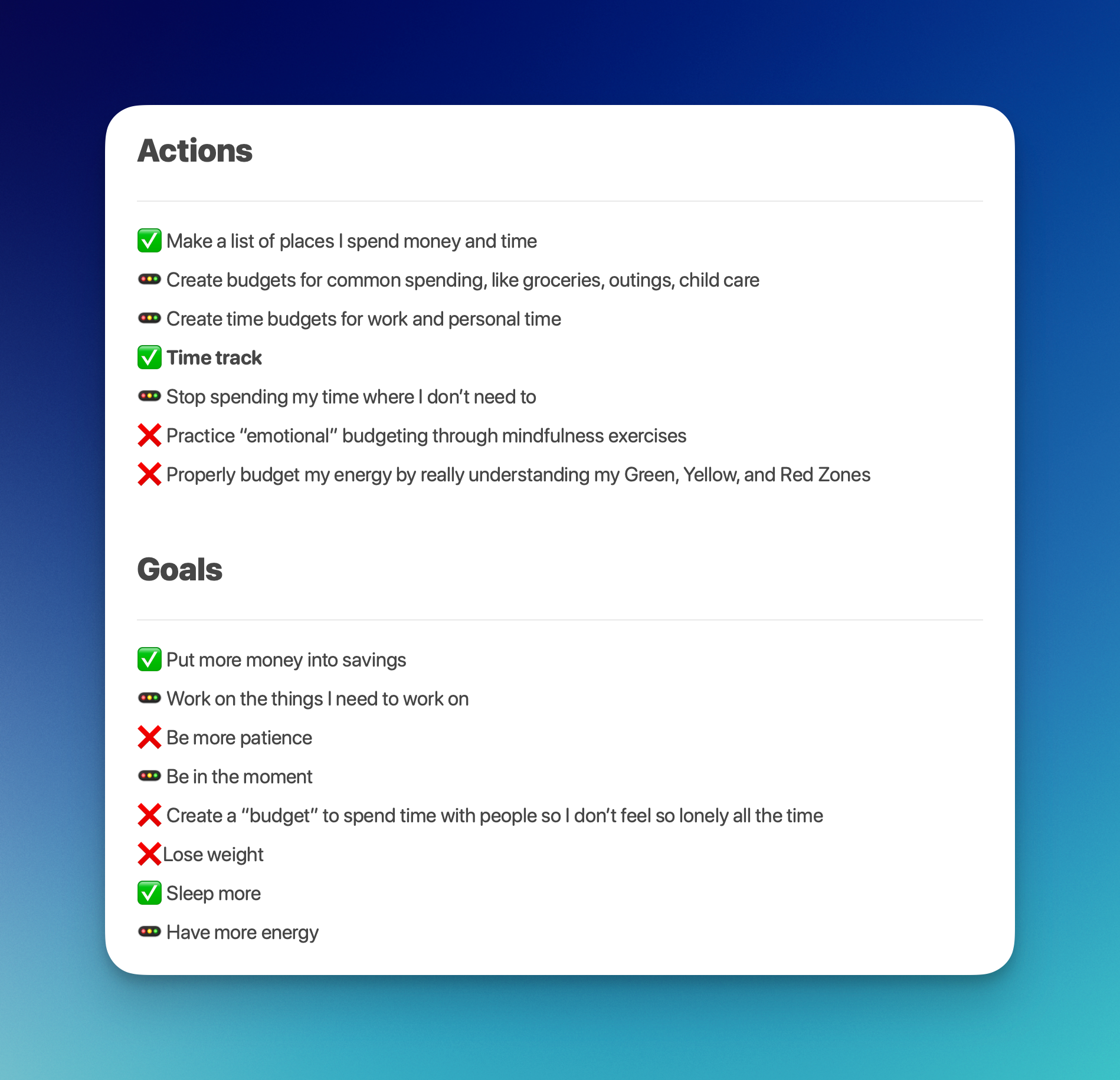
These are not high-minded, open-ended questions. There are actual things I could do.
I didn’t have anything like that for The Year of Control; just vague instructions like, “control impulses,” and “improve health.”
Without a strong foundation to base my theme on, it was difficult to stay the course and make any improvements when life got in the way.
And that happened a lot in 2024.
Small Kids, Aging Parents, and Other Factors
The truth is, there are several areas of my life I don’t control right now. It’s the stage I’m in. I have 3 small kids who need a lot. My wife works full time as a nurse, so my schedule is de-facto more flexible.
My parents are in their 70s; dad fell at home, and my brothers and I moved them out of our childhood home. They had to stay in New York for multiple reasons, so they moved closer to my brother Phil, and further from me.
That means he’s bearing a lot of the brunt on the day-to-day health stuff, but we’re helping where we can, and we are trying to make the 5-hour trip once every few months.
Outside of family, there were just a lot of frustrating, extenuating factors that made me feel like I was losing control, not gaining more.
It’s hard to account for the unknowns in life, and at this point in mine, they seem to be happening more frequently. Having small kids and aging parents makes for a capricious existence. Knowing and understand that is crucial, and while I do now, I didn’t at this point last year.
Plus, we just got a dog (I got outvoted 4-1). Since I work from home, I know it will have an impact on my workdays1.
Overall Grade: F
I didn’t do anything that I could reasonably say made me feel more in control. If anything, I went in the wrong direction.
I may as well have set no yearly theme.
Part of it is I didn’t adhere to the few rules I set for myself. Part of it is there weren’t enough specific actions I could take — it was too high level. And part of it was extenuating circumstances I wasn’t prepared enough to deal with.
Last year, when I introduced The Year of Control, I stated Conrol was a natural successor to Budgets:
As I reflect on The Year of Budgets, I can’t help but think “Control” is the next logical step.
But I didn’t realize there was a prerequisite to Control, and that’s Presence.
The Year of Being Present
First, here’s what the yearly theme is about:
Focus on mindfulness, intentionality, and living in the moment by reducing distractions, setting boundaries, and addressing issues as they arise2.
Concretely, I want to enjoy the moments with my family instead of worrying about work or mindlessly scrolling.
I don’t want to sacrifice the present, thinking about the future.
Something I found myself doing increasingly last year was escaping into my phone. Combine that with a truly detrimental multitasking habit, and I easily came up with a basic set of goals that will make this theme a success:
- Reduce screen time. This one is obvious. When I’m out, I’m on my phone less than most. But at home, I’m on it far too much.
- Create stronger boundaries. I used to have a rule that my laptop wasn’t allowed upstairs. The pandemic ruined those boundaries, and I’d like to reset them.
- When I’m on calls, stop doing on other stuff . It’s straight up rude.
- Stop deferring to the future. If something needs to be improved, do it now instead of making it a problem for future Joe.
- Always have cash . This simple task will help keep me rooted in the real world.
- Be better at managing assumptions. I assume the worst and catastrophize, which takes me out of the present and into some future that likely will not happen.
But, as I learned with The Year of Control, a list of goals isn’t enough.
Planning my Theme
Let me address what, I think, was the biggest contributor to last year’s theme’s failure: lack of planning.
In the 2025 Yearly Themes episode of Cortex, Myke and Grey talk about using LLMs like ChatGPT and Claude to help brainstorm; I really leaned into that.
With some prompting and context, I used ChatGPT to come up with a better definition and roadmap for making my theme as successful as possible this year.
This, coupled with the fact that I have Daily, Weekly, and Monthly notes in Obsidian, and I can make my yearly theme prompts and actions much more present in my daily life.
I basically asked it to think of what I’m missing from my theme, better flesh out the goals, and create a roadmap for success.
Then we came up with a quarterly plan, prompts, and monthly reflections.
The Roadmap
Here’s a brief overview of the roadmap, focusing on the key actions for each quarter:
Q1: Build Awareness
- Track screen time and identify major distractions.
- Set boundaries for work and personal time.
- Start a “fix it now” habit for small, immediate tasks.
Q2: Solidify Habits
- Refine my boundaries and adjust based on what works.
- Focus on single-tasking during calls and meetings.
- Add no-phone zones or screen-free hours to my day.
Q3: Deepen Your Practice
- Address major friction points in my routines and workflows.
- Strengthen communication with loved ones and colleagues.
- Schedule device-free time to build stronger connections.
Q4: Reflect and Celebrate
- Review what worked and what didn’t.
- Identify lasting changes to carry forward.
- Celebrate progress and plan for the next year’s theme.
Overall, I like the tiered approach that we (mostly ChatGPT) came up with here. It’s a stark contract to last year’s plan of, “Change everything starting in January.”
While I am tracking screen time (and my working time) already, I want to be more reflective about this in Q1. I seldom review screen time reports except to see my weekly average.
I also have a few tools I’m already using; refining my use of these tools (which I’ll tell you about shortly) will be crucial to the success of this yearly theme.
Prompts
There are also several questions I’ll be asking myself regularly — they’re already part of my weekly and monthly notes, so I won’t miss them.
Moreover, there are specific check-ins/prompts for each quarter.
Weekly Reflection
- When do I feel most present, and how can I recreate those moments more often?
- What habits or distractions pull me away from being fully engaged in the present?
- What boundaries do I currently lack that would help me feel more grounded?
- How can I break the habit of procrastination for small, actionable tasks?
- How do I communicate my boundaries and needs to others effectively?
- What triggers make me act on assumptions rather than seeking clarity?
Monthly Check-Ins
- “Am I spending less time on screens and more time being present?”
- “What boundaries are working well? What needs adjustment?”
- “What small, immediate fixes can I tackle this month?”
- “How can I improve my presence in relationships and work?”
Helpful Tools
I’ve already stated my goals, and the roadmap is in great shape, but there are a few specific, implementation-level actions I’d like to take.
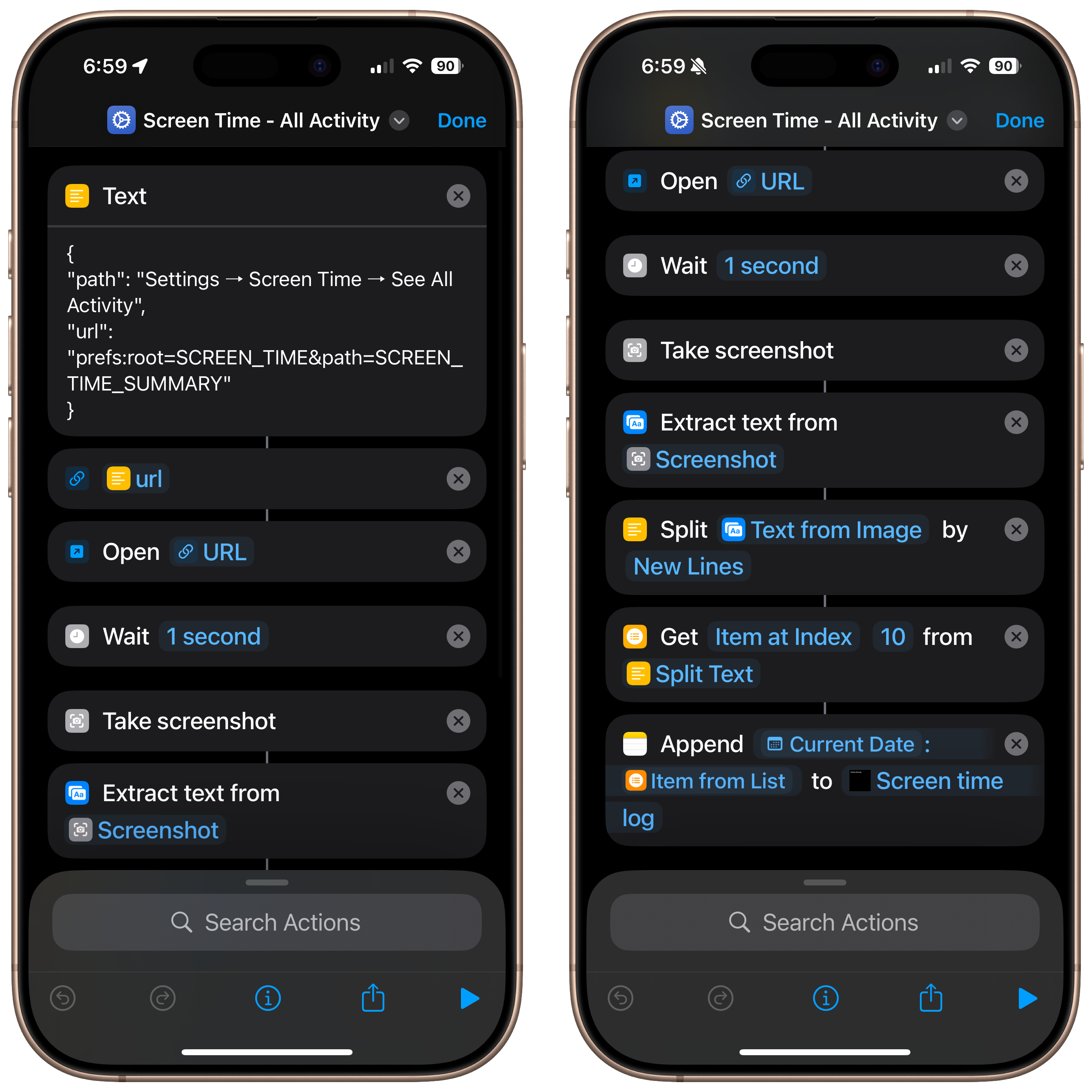
First, iOS’s Screen Time data only goes back 3 weeks, which is incredibly frustrating. So I wrote a shortcut that will grab that info and log it each Sunday (I will share it once I test it some more), but here’s its current form:
I’m also using The Brick to limit my phone use. I have a couple of modes right now: Default (blocking the most distracting apps), Deep Work (allowing only the most crucial apps), and Bed Time (allowing the most crucial apps, and some apps I’m allowing at bedtime).
I have made it a habit to scan the Brick in the morning on weekends, and at night before bed. A second one for my office for “deep work” sessions may be in my future, so I don’t have to go upstairs.
I’m also going to use the Focus Mac app more, which does what the Brick does, on my Mac. This also allows for multiple modes, such as one for deep work and another for calls.
Tool-based Actions
Based on all of this, I’d like my actions to be:
- Brick my phone for at least 4 hours each day, not counting bedtime.
- Be in a Focus Mode on my computer for at least 3 hours each work day.
- Review Screen Time and Tracked Time each week as part of my start-up routine
What About Outside of Screen Time?
A lot of my focus for implementation has been on device use safeguards. I intend to be more present in real life, and they will help.
However, there are 4 more actions I intend to take that are device-agnostic:
- Go to the ATM every Monday after school drop off
- Call my parents every other day
- Make actual, tangible plans with friends once per month
- Do more “friend” trips instead of (or in conjunction with) work trips
If you’re wondering what the cash thing is about, here’s the quick backstory…
I used to always have cash on me. It’s important, in-case someplace doesn’t accept card/Venmo/check/whatever. This is often the case at small, community events.
But I also like tipping folks with cash — and since the pandemic, I’ve had cash on me so infrequently that I’ve resorted to clumsily tipping with Venmo, or not tipping at all. And I hate that.
It made me feel like I wasn’t fully prepared for the events of the day, and that I was pushing off this simple task for future Joe.
Having cash is a small, simple way to keep me rooted in real-world activities — something I’m not relying on a digital tool for.
I’m Excited
This is the most thorough plan I’ve had for a yearly theme ever. I’m excited to see how it affects my day-to-day, my reliance on devices, and my relationships.
I’ll intend to publish updates here at some interval — call it public accountability.