
Manifest Development Redesign 2011: Custom Widgets
In Parts 1 and 2, I talked about the two most important parts of the site- the homepage and portfolio. Today I want to talk about a more subtle, but still important, part of the site- the sidebar.
With the ubiquity of WordPress driven websites on the Internet, sidebars and their individual components (called widgets) have become a staple of designing a website. The goal of the sidebar (sometimes referred to as an aside) is to provide supplementary information to the user; this is content that does not belong with the main content, but helps it in some way. On the Manifest Blog, the sidebar consists of archives by date and category. Since I treat the blog as more of a stand alone site, I wanted to do something different for the other pages. I set out to create a set of three custom widgets that I could update from within WordPress. I could have more easily hardcoded them into my theme, but I wanted to have the option of switching them out in the future.
The first one is a “Learn More” widget. It simply displays a block of text with a link to my Introductory PDF. The second one is the “Availability” widget. I saw something similar on other websites and liked the concept- it tells my users how busy I am with projects. I simply check or uncheck a box from within WordPress, and the widget displays the appropriate text.

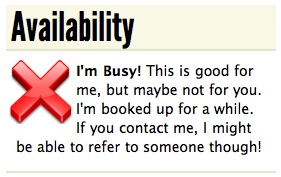 The “Learn More” and “Availability” widgets appear on every page that is not part of my blog.
The third widget, a Contact widget, appears only on the contact page. It shows my phone, fax, email, and links to Manifest Development’s Facebook, and Twitter profiles. So it wouldn’t be a clone of the footer widget, I made two changes. The first was removing the social media icons, as well as the link to LinkedIn. I felt that the icons took away from the content too much, and since the LinkedIn profile is my personal one, it doesn’t really belong in the sidebar. The second change was adding my virtual card (vcard) for anyone to download and add to their address book.
In the future I may generalize these widgets for release. I know there are people out there who would find them as useful as I do. I’ll also be publishing a quick tip on how to create your own vcard using a text editor.
